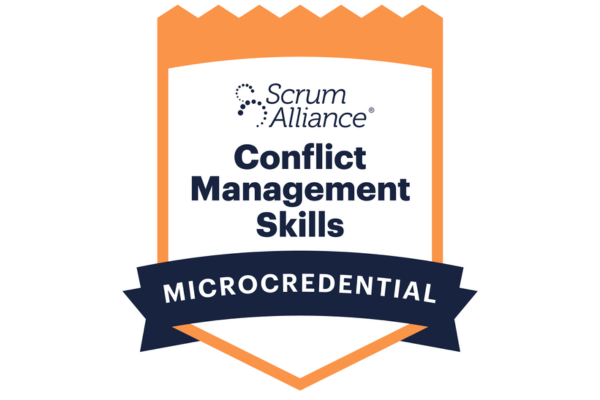
Conflict is inevitable, but when managed well, it can strengthen teams. Conflict Management Skills helps individuals and teams move through disagreement with clarity, empathy, and alignment. You’ll learn the dynamics of conflict, how to work toward resolution, and how to support psychological safety so teams can collaborate effectively and deliver more value.
· Learn through practical exercises in a highly interactive format
· Apply skills using real-world scenarios and simulations
· Guide teams through conflict and difficult conversations
· Navigate personal conflicts effectively and professionally
· Identify conflict triggers and early warning signals
· Hone de-escalation skills to reduce tension and restore alignment
· Understand the importance of psychological safety in high-performing teams
What you’ll learn (learning outcomes)
By the end of Conflict Management Skills, you’ll be able to:
- Recognise common sources and signals of conflict in Agile teams
- Use practical techniques to address conflict in a healthy, productive way
- Support inclusive dialogue and build shared understanding
- Foster trust and accountability in team dynamics
Why conflict management matters
High-performing teams rely on effective communication, mutual respect, and trust. Conflict management supports that foundation, helping teams surface issues early, reduce misunderstandings, and stay focused on outcomes. When conflict is handled constructively, teams strengthen collaboration, improve decision-making, and maintain momentum.
Who this micro-credential is for?
Conflict Management Skills is ideal for:
- Team members, leaders, and facilitators
- Scrum Masters and Agile Coaches
- Anyone looking to strengthen team collaboration and psychological safety
Course modules
Module 1: Preparing to Tackle Conflict
· Recognise conflicts or potential conflicts within a team.
· Demonstrate composure in expected or unexpected conflict situations.
· Identify triggers that may lead to conflict.
Module 2: Understanding Conflict Inside Out
· Consider the perspectives and concerns of all parties involved in a conflict.
· Analyze how different backgrounds and cultures influence conflict dynamics.
Module 3: De-escalating Tensions
· Apply de-escalating techniques that foster a collaborative and constructive team environment.
· Develop facilitation skills of remaining neutral to guide others through a resolution process.
· Develop facilitation skills to mediate discussions and guide individuals and teams through resolution.
· Develop facilitation skills to manage power dynamics and guide others through the conflict resolution process
Module 4: Mastering Conflict Management
· Create an original conflict management plan based on best practices and resolution strategies.
How is this course delivered?
Instructor-led, this 1-day course is delivered live with our facilitator. The course is designed to be highly interactive, with practical exercises, discussion and scenario-based learning.
Bring us onsite and our facilitator can deliver training for your team at your premises. Private courses can also be conducted in our virtual classroom on dates and times that suit your teams, ideal for remote or hybrid workforces.
Request a quote and our team will be in touch with a proposal.
What’s included in your course fee?
· Access to Scrum Alliance’s official course materials via the ITSM Hub learning portal
· A Conflict Management Skills digital badge to showcase your new skills
FAQs
- What is a micro-credential?
Micro-credentials are short, flexible, industry-aligned qualifications that certify a specific, in-demand skill or competency. They’re designed for rapid upskilling or reskilling and are often issued as a verified digital badge you can share with employers and on social platforms like LinkedIn. Many micro-credentials can also be stackable over time toward broader learning pathways. - Will I receive a digital badge?
Yes. You’ll receive a digital badge to showcase your knowledge once you complete Scrum Essentials. This micro-credential badge never expires. - Who is Scrum Alliance?
Scrum Alliance is a global, not-for-profit professional membership and certification body best known for advancing Scrum and Agile practices worldwide. It supports a broad community of practitioners, coaches, and leaders through education, credentialing, and continuous learning. - What are Scrum Alliance micro-credentials?
Scrum Alliance micro-credentials are bite-sized, targeted learning experiences that validate specific skills and knowledge areas. They’re ideal for professionals who want to upskill quickly, build capability for a new role or responsibility, strengthen Agile ways of working across teams, and demonstrate ongoing professional development. - Why do micro-credentials matter for ITSM and digital teams?
Many IT and service organisations operate in hybrid environments, balancing ITIL/ITSM practices with Agile delivery, product management, and DevOps ways of working. Micro-credentials make it easier to build Agile capability across the organisation in a practical, low-friction way. They’re particularly valuable for service management professionals working alongside Agile delivery teams, product and platform teams, leaders reinforcing Agile behaviours without long programs, and teams adopting Scrum who need a consistent baseline. - Are micro-credentials worth it?
Micro-credentials are a practical way to continually add new skills with fast, flexible formats. Key benefits include faster focused upskilling, role-aligned learning, practical outcomes (not just theory), cost-effective professional development, scalable capability building across teams, and stronger alignment between ITSM and Agile delivery. -
Why is conflict management important?
Unchecked conflict not only steals a team's focus, but it has a tendency to spread across teams and organizations, lowering overall morale and productivity and impeding a culture of trust, transparency, and collaboration.For those reasons alone, it's essential to have employees at your organisation who know how to navigate people through conflict. Whether you want to take on this role yourself or train employees at your organisation, Conflict Management Skills is a great place to start.
Recent customers





An amazing instructor who explained the content very clearly and at a very good pace. This was a good balance and approach. I found the worked examples very practical and very relatable to the Defence industry sector I work in.
Really good facilitation, kept me interested and shared so many practical applications.
Gave me a better understanding of concepts, theories and tools to formalise and improve my current relationship management.
The instructor was very professional and was able to explain each area thoroughly and is available for Q&A.
Learnt a lot that we can implement or improve on in our organisation. The presenter was clear, precise and could relate difficult concepts into language and scenarios we could relate to. Everyone came away from the course feeling that had learnt something valuable.
Catholic Education, Brisbane
The examples provided by the instructor as we were covering of material, made everything make sense. This helped during the exam. Pat was fantastic and engaging. Kept everyone on their toes and ensured he took the time to explain anything we were not clear on.
BAI Communications
The instructor was great and very interactive. He made sure we understood the material and gave ample opportunity for us to ask questions. He provided great examples which tied everything in.