

ITIL has always evolved to reflect how organisations deliver value through technology, without forcing people to start over. ITIL (Version 5) continues that tradition. This is as an evolution of ITIL, not a reset: existing certifications remain valid, and the new qualification scheme is designed to be clear, progressive, and role-aligned.
Whether you’re brand new to ITIL or you’ve been practising since v3 or ITIL 4, Version 5 adds practical guidance for today’s reality: integrated products and services, experience-led value delivery, and AI-ready operating models.
In Summary
-
ITIL (Version 5) builds on the strengths of ITIL 4 while adapting the framework for modern digital environments.
-
It introduces a unified product and service lifecycle, stronger experience-driven practices, and practical guidance for the AI era.
-
It’s perfect for professionals looking to develop their IT services and products management, while offering clear progression paths
What is ITIL and why it keeps evolving
ITIL is a globally recognised best-practice framework for IT service management (ITSM) and, more broadly, enterprise service management and product and service management. It gives organisations a shared language, principles, and practical guidance to improve outcomes.
Over time, ITIL has expanded its scope:
- ITIL v1 (1980s): process-based IT service management
- TIL v2 (2000): stronger integration across service delivery and support
- ITIL v3 (2007/2011): the lifecycle approach (strategy, design, transition, operation, continual improvement)
- ITIL 4 (2019): service value in the digital era (value co-creation, flexibility, Service Value System)
- ITIL (Version 5) (2026): product and service management for a digital and AI-driven world

The throughline is stability with modernisation: ITIL generally protects existing investments while updating guidance to match how organisations actually work.
What stays the same in ITIL (Version 5)
For experienced practitioners, the biggest reassurance is continuity.
- It’s an evolution, not a revolution. Your existing ITIL learning and certifications retain value.
- ITIL Guiding Principles remain central (often described as “the soul of ITIL”).
- Global recognition and trust remain. ITIL continues to be a widely adopted standard.
- The 34 ITIL Practices remain unchanged in scope and structure (with only minor terminology updates).
- Compatibility is a priority, including alignment with existing tools and assessments.
What’s new in ITIL (Version 5)
ITIL (Version 5) introduces shifts designed to better match modern operating models:
1) A unified digital product and service lifecycle
A major visible change is a unified Product and Service Lifecycle, intended to create clearer end-to-end flow and strengthen predictability across delivery.
The lifecycle activities are described as:
- Discover
- Design
- Acquire
- Build
- Transition
- Operate
- Deliver
- Support
This unifies product and service management so organisations can deliver consistent value across stages and business units.
2) Stronger focus on customer and employee experience
Version 5 increases emphasis on experience-driven adoption and value delivery. A new publication, ITIL Experience, is positioned to help leaders and professionals design and manage service experiences using principles, methods, metrics, and practical tools.
3) Clearer roles, responsibilities, and outcomes
ITIL (Version 5) places more emphasis on accountability and measurable performance, supporting organisations that need clearer ownership and outcome-based ways of working.
4) AI-native guidance and AI governance
ITIL (Version 5) is designed for AI-enabled environments, with AI-native guidance across modules and a new publication, ITIL AI Governance, focused on responsible AI and practical governance steps.
5) More practical strategy and implementation guidance
Two additional publications are positioned to strengthen enterprise adoption
- ITIL Strategy: direction, priorities, governance, and value measurement
- ITIL How to Implement: practical, context-aware guidance for enterprise-wide transformation
6) Foundation as the single entry point
ITIL (Version 5) positions Foundation as the single entry point, alongside a simplified qualification scheme aligned with job roles.
The ITIL (Version 5) certification scheme

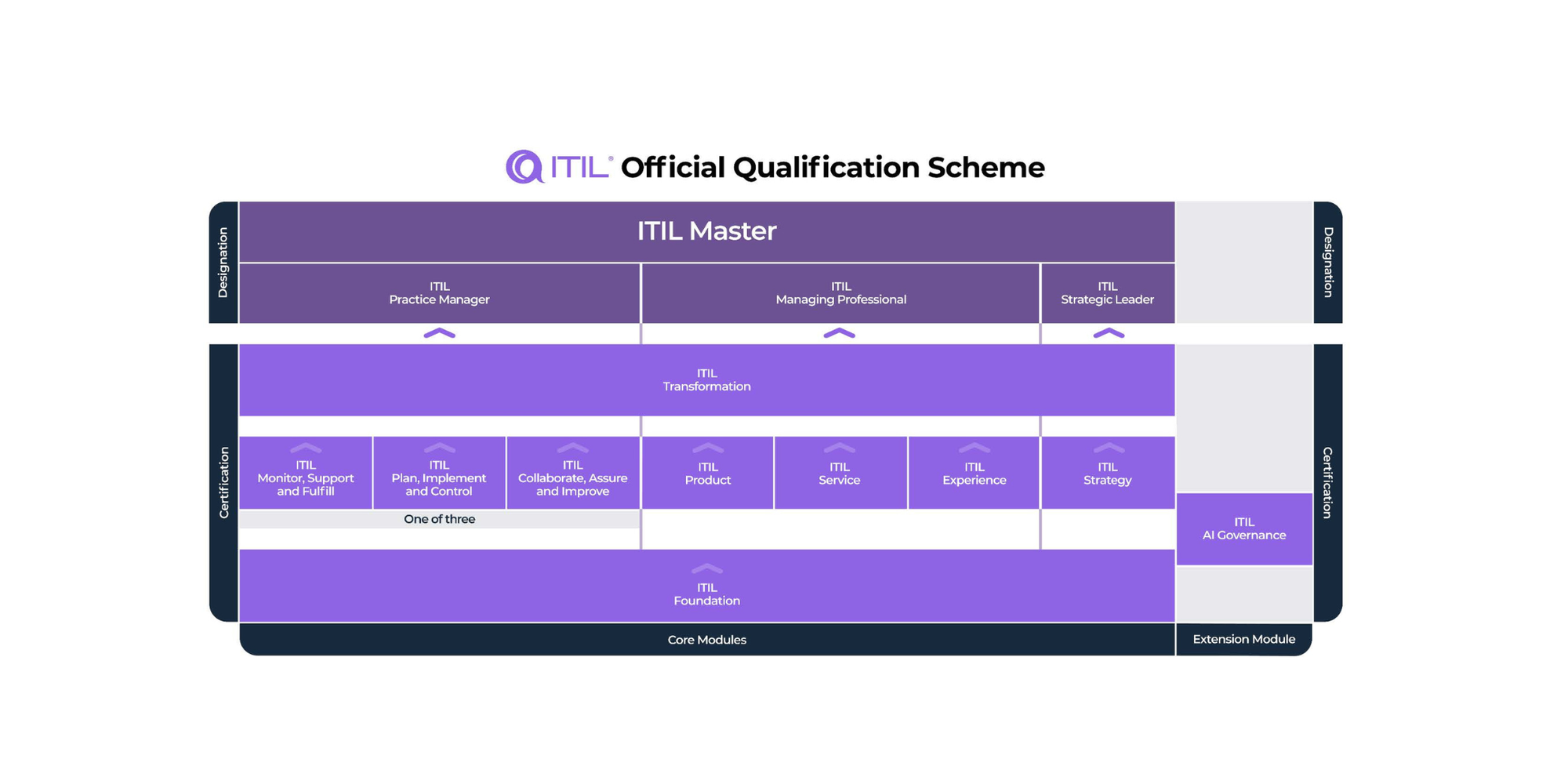
The qualification scheme starts with ITIL Foundation and continues with advanced modules organised into three streams
- ITIL Practice Manager (ITIL PM)
- ITIL Managing Professional (ITIL MP)
- ITIL Strategic Leader (ITIL SL)
Completing the required modules in a stream awards that designation. Achieving all three designations leads to the highest recognition: ITIL Master.
Practice Manager (ITIL PM)
After Foundation, choose one specialisation module:
- Monitor, Support & Fulfil (MSF): Service Desk; Incident; Problem; Service Request; Monitoring & Event
- Plan, Implement & Control (PIC): Change Enablement; Deployment; Release; Service Configuration; IT Asset
- Collaborate, Assure & Improve (CAI): Relationship; Supplier; Service Level; Continual Improvement; Information Security
To receive the ITIL Practice Manager (Version 5) designation, you also complete ITIL Transformation.
Managing Professional (ITIL MP)
Strategic Leader (ITIL SL)
The universal module: ITIL Transformation
ITIL Transformation is a core module across ITIL Practice Manager, ITIL Managing Professional, and ITIL Strategic Leader. You only need to complete it once, and it counts across all designations.
Extension module: AI Governance
AI Governance is the only extension module in the ITIL (Version 5) scheme. It focuses on frameworks, policies, and controls for responsible AI.
ITIL exam and what candidates should expect
- Closed book Multiple-Choice Questions: ITIL Foundation (Version 5); ITIL Practice certifications; ITIL AI Governance
- Open book planned: ITIL Product; ITIL Service; ITIL Experience; ITIL Strategy; ITIL Transformation
For Foundation, self-study is allowed. ITSM Hub provide ITIL Foundation exam vouchers only or we have a cost effective self-paced online option. To provide you with the course materials and confidence to pass the first time. For all other ITIL modules, accredited training (or official eLearning) is required, ITSM Hub provide the full suite of ITIL courses. Register your interest here
Transition pathways: from ITIL v3 or ITIL 4 to ITIL (Version 5)
ITIL (Version 5) is designed to respect existing investments and make progression straightforward.
If you’re coming from ITIL v3
In most cases, the recommended approach is simple:
- ITIL v3 Foundation (or Intermediate/Capability): start with ITIL (Version 5) Foundation to cover new topics and align to the updated framework.
For advanced v3 designations:
- ITIL Expert (v3): eligibility for ITIL (Version 5) Managing Professional is subject to review; a Managing Professional Transition (MPT) module has been listed as under review.
- ITIL Master (v3): transition guidance is also subject to confirmation; some options are under review.
If you’re coming from ITIL 4
The pathways are designed to keep momentum
- ITIL 4 Foundation: remains a recognised prerequisite for advanced ITIL (Version 5) modules, no need to retake Foundation
- ITIL 4 Practice Manager: structured transition path using the designated transition module and assessment.
- ITIL 4 Managing Professional / Master: expect a Managing Professional Transition (MPT) route focused on what’s changed (including Product, Service, Experience, Transformation)
- ITIL 4 Strategic Leader: structured transition via the ITIL Transformation option.
Important note: transition guidance is subject to confirmation following testing.
ITSM Hub will have the full course suite available as they are released. Register your interest to be the first to know.
Will ITIL 4 be retired immediately?
No final retirement date has been announced. ITIL 4 and ITIL (Version 5) are expected to run in parallel for a minimum of 12 months, allowing candidates and organisations to complete in-flight learning journeys.
ITIL (Version 5) vs ITIL 4: What’s the Difference?
While ITIL 4 introduced the Service Value System (SVS) and the concept of value co-creation, ITIL (Version 5) goes further by providing clearer operational guidance.
Key differences include:
|
ITIL 4 |
ITIL (Version 5) |
|
Service Value System |
Unified Product & Service Lifecycle |
|
Value co-creation emphasis |
End-to-end lifecycle execution |
|
Digital transformation focus |
AI-enabled operations and governance |
|
Flexible operating models |
Clearer roles, responsibilities and outcomes |
In short, ITIL (Version 5) provides more practical implementation guidance for organisations already operating in digital and AI-enabled environments.
Why ITIL (Version 5) matters for your business
ITIL (Version 5) arrives at a time when organisations are managing far more complex digital ecosystems than ever before. Teams are no longer delivering standalone IT services. Instead, they deliver integrated digital products, platforms, and experiences.
Modern organisations are also operating with:
-
AI-assisted operations and automation
-
Cross-functional product teams
-
Continuous delivery models
-
Experience-led service design
ITIL (Version 5) reflects these realities by aligning IT service management with product thinking, customer experience, and AI governance.
Rather than treating IT services as operational support functions, the new ITIL encourages organisations to see them as value-creating products within the wider business ecosystem.
Start Your ITIL (Version 5) Journey with ITSM Hub
ITSM Hub are running ITIL Foundation (Version 5) classes on 12–13 February (APAC time) and 16-17 February (UK time) being some of the first course deliveries in the world.
If you want to register and certify early, this is your opportunity to get ahead of the curve and be among the first professionals globally to hold the new credential.
Want help choosing the right pathway? Tell us your current ITIL certification level (v3 or ITIL 4) and your role goals, and we’ll map the fastest route.
FAQs:
Who should take ITIL (Version 5) courses?
ITIL (Version 5) courses are suitable for ITSM professionals, service delivery managers, product managers, digital transformation leaders, and anyone involved in enterprise service management. The framework benefits both new learners and experienced ITIL practitioners looking to update their skills.
Do I need ITIL v3 or ITIL 4 to start the new ITIL?
Prior experience is helpful but not mandatory. The new ITIL Foundation serves as the universal entry point. Professionals transitioning from ITIL v3 or ITIL 4 can follow structured pathways to continue advancing without losing prior certifications.
Can ITIL (Version 5) help with career growth?
Yes. ITIL (Version 5) certifications validate modern skills that are highly sought after in IT service management and digital transformation roles. Earning these credentials can increase employability, expand leadership capability, and demonstrate expertise in AI-aware service management.